
If you carefully observe the Chinese market, you will discover how unique its scale and industry are. According to statistics from 2023, in Yiwu Small Commodity City in Zhejiang Province, the sales of various cheap small commodities that circulate worldwide alone amounted to 30 billion US dollars, while in Dongguan, Guangdong Province, which is mainly oriented towards foreign trade in the south, the clothing export volume in 2023 was 182 billion US dollars, accounting for 31.7% of the global market share. In Shaodong, an inconspicuous place in central southern China’s Hunan Province, the annual production of lighters reaches 3.5 billion, with an annual turnover of over 2 billion US dollars. Even in Guangzhou, the third largest city in China, hundreds of thousands of garment processing workers gather, and not far from these garment processing factories is the city’s dazzling landmark building, the Canton Tower. At the same time, in this country, BYD’s electric vehicle exports alone reached 433000 units in 2024, a year-on-year increase of 71.8%. The Fuxing CR450 bullet train, with a commercial operating speed of 450 kilometers per hour, is ready to be put into operation, and the recently shocking Deepseek has emerged.
Witnessing all of this creates the illusion of time and space interweaving: are all these events happening simultaneously in the same country?
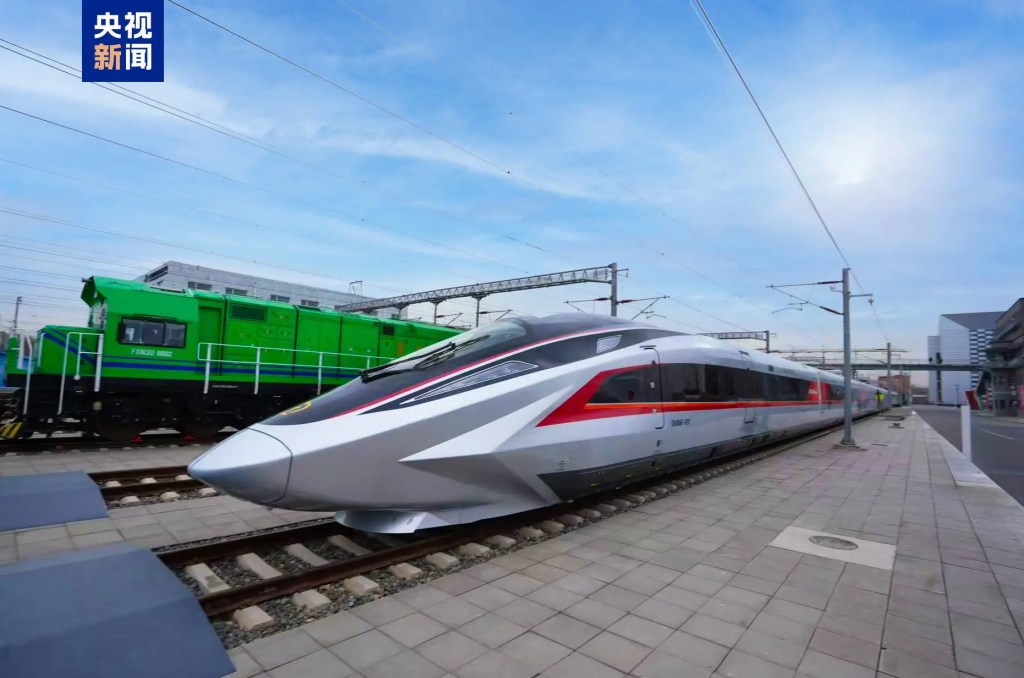
This photo shows a prototype of CR450 bullet train (CCTV news)
As global supply chains evolve under geopolitical pressures, a growing discourse suggests that China may hold the distinction of being the world’s “last industrialized nation.” Analysts highlight China’s unparalleled integration of scale, cost efficiency, and a comprehensive industrial ecosystem—from low-end manufacturing to cutting-edge technology—as factors cementing its irreplaceable role in global production. Despite tariffs and foreign investment shifts driven by the U.S. and Europe, China’s robust infrastructure, stable power networks, and mature supply chains continue to outpace competitors.
China’s Industrial Dominance
China’s industrialization journey, accelerated over four decades, has culminated in a full industry chain capable of producing 40% of the world’s manufactured goods. The nation’s $17.7 trillion economy thrives on seamless coordination between suppliers, manufacturers, and logistics networks, bolstered by strategic state investments in highways, ports, and renewable energy. Even as some industries relocate to Southeast Asia and South Asia, experts argue that no country can yet replicate China’s blend of scalability, skilled labor, and institutional coordination.
The India Contrast: Structural Hurdles to Industrialization
India, often cited as a potential rival due to its 1.4 billion population, faces multifaceted barriers. Chronic infrastructure gaps—such as inadequate roads and unreliable electricity—hamper factory output. Bureaucratic inefficiency and corruption deter foreign investors, with India ranking 85th in Transparency International’s 2022 Corruption Perceptions Index. Additionally, brain drain and social fragmentation, fueled by religious and caste tensions, undermine workforce cohesion. While India’s tech sector thrives, transforming its agrarian base into a broad industrial economy remains elusive.
Challenges for Southern Nations
Beyond India, developing countries across the Global South confront shared obstacles:
- Infrastructure Deficits: Many lack China’s decades-long investment in transportation and energy grids.
- Political Instability: Weak governance and corruption disrupt long-term industrial planning.
- Education Gaps: A shortage of technical training limits high-value manufacturing capabilities.
- Capital Access: Scarce domestic savings and volatile foreign investment hinder growth.
- Social Divisions: Ethnic or religious conflicts destabilize economic environments.
Is China the “Last Industrialized Nation”?
The argument hinges on China’s unique ability to merge state-led strategy with market adaptation. While replicating its model appears daunting, emerging economies like Vietnam and Indonesia show promise in niche sectors. Yet, their scale pales against China’s dominance. Geopolitical shifts and climate-driven industries may offer new opportunities, but overcoming systemic challenges demands unprecedented coordination—a feat few nations have achieved.
Conclusion
China’s industrial supremacy, forged through strategic planning and vast resources, presents a high bar for competitors. While not impossible, the path to industrialization for others is fraught with structural, political, and social hurdles. As the global economy rebalances, China’s role as the linchpin of manufacturing seems secure—for now.
 deepworldnews.com
留下评论