
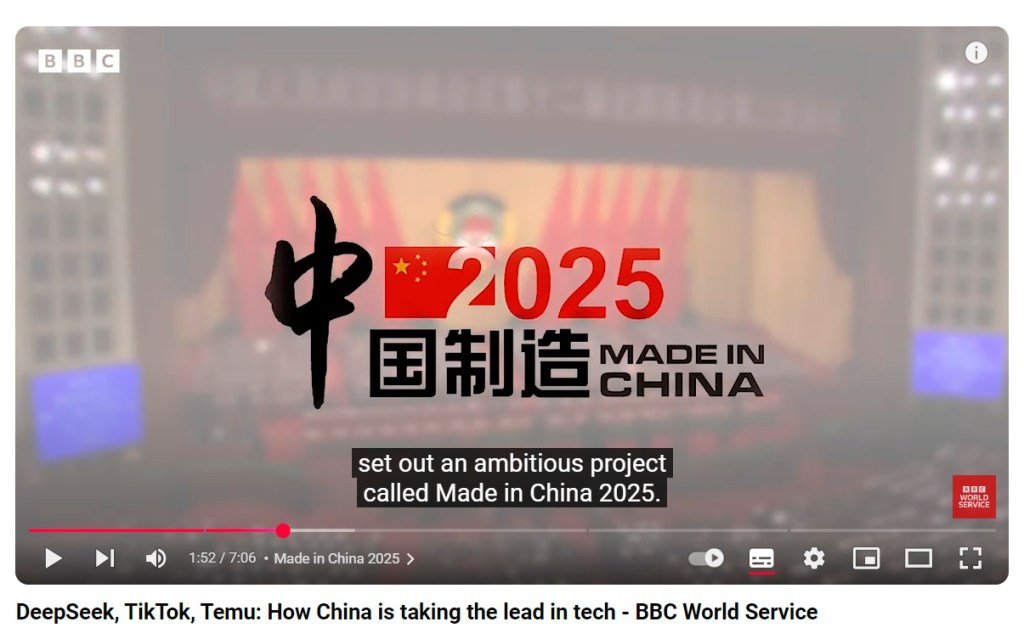
When China unveiled its ambitious Made in China 2025 (MIC 2025) initiative in May 2015, it marked a pivotal shift in the nation’s economic strategy. The plan, designed to transition China from a manufacturing giant reliant on low-cost labor to a global leader in high-tech industries, has stirred significant unease in Western capitals. As the decade-long roadmap nears completion, its successes—and the West’s response—reveal a complex interplay of economic rivalry, technological competition, and geopolitical maneuvering.
The Plan and Its Promises
MIC 2025 targeted dominance in ten critical sectors: electric vehicles (EVs), energy and power generation, shipbuilding, high-speed rail, aviation and aerospace, biotechnology, advanced materials, robotics, semiconductors, and agricultural machinery. By 2025, China aimed to lead in innovation, quality, and efficiency, reducing dependence on foreign technology. Eight years in, the BBC and industry analysts report notable strides in EVs, renewable energy, shipbuilding, and high-speed rail, with China now dominating global EV production and high-speed rail networks. Aerospace, biotech, and robotics are nearing targets, while semiconductors remain a battleground. Only agricultural machinery lags, hindered by structural challenges and market fragmentation.
Western Fears: Root Causes
- Economic Competition:
MIC 2025’s focus on sectors like EVs and renewables threatens Western industries. China’s state-backed subsidies and economies of scale have enabled firms like BYD and CRRC to undercut competitors, raising fears of market monopolization. The EU and U.S. worry about deindustrialization as manufacturing shifts eastward. - Technological Supremacy:
Success in semiconductors, AI, and 5G is seen as a gateway to global influence. China’s advancements in green tech and telecommunications, coupled with allegations of intellectual property theft and forced technology transfers during joint ventures, have fueled concerns about unfair practices. - State-Led Industrial Policy:
Western market-driven economies view China’s state subsidies, preferential loans, and procurement policies as distortions of free trade. The U.S. Trade Representative criticized MIC 2025 as a “state-backed blueprint for dominance,” prompting tariffs under the Trump administration and stricter export controls on advanced tech. - Geopolitical Implications:
MIC 2025 aligns with China’s broader ambitions to reshape global governance. Leadership in critical infrastructure (e.g., high-speed rail via Belt and Road Initiative projects) and dual-use technologies (e.g., drones, aerospace) amplifies fears of a Sino-centric world order challenging U.S. hegemony.
The Resilience of China’s Strategy
Despite U.S. sanctions—particularly on semiconductor firms like SMIC and Huawei—China has accelerated R&D investment, filing more patents than the U.S. since 2019. The BBC notes that export restrictions inadvertently spurred domestic innovation, with China achieving milestones in quantum computing and hypersonic tech. Analysts argue that the U.S. struggle to contain China’s rise underscores the limitations of decoupling in a globalized economy.
Downplaying Without Retreating
Facing Western backlash, China publicly softened references to MIC 2025 after 2018, avoiding overt rhetoric. However, funding flows continued through provincial initiatives and national tech funds. This pragmatic shift reflects China’s adaptive state capitalism, prioritizing progress over propaganda.
The Road Ahead
As 2025 approaches, MIC 2025’s mixed outcomes highlight both China’s strengths and vulnerabilities. While EVs and renewables thrive, semiconductor self-sufficiency remains elusive, with advanced chips still imported. Agricultural machinery’s underperformance signals sector-specific hurdles. Yet, the plan’s core success—repositioning China as a tech innovator—has solidified its global standing.
Conclusion
The West’s apprehension toward MIC 2025 stems from a recognition that China’s rise is not merely economic but systemic. The initiative challenges Western technological and ideological paradigms, proving that containment is increasingly untenable. As the U.S. and EU recalibrate strategies—through the CHIPS Act or Green Deal Industrial Plan—the lesson is clear: in the 21st-century tech race, innovation, not isolation, will dictate dominance. China’s journey underscores that the future of global power may indeed be made, but not exclusively in the West.
The west may also have a deeper fear of the success of the plan: they have always thought that they have a stereotype of the Chinese people, who, although smart and diligent, are constrained by rigid systems and lack innovative thinking. And China’s recent series of technological breakthroughs have broken this bias: China’s system and technological innovation are full of vitality. For Westerners, this is the biggest fear because it means that China’s success has provided another successful example and choice for the world. But Western countries can also draw inspiration from China’s success: the innovative ecological model of government led+large enterprises+small enterprises can make miracles happen.
 deepworldnews.com
留下评论