

When Argentine President Javier Millet came to power in 2023, the government implemented a “shock therapy” to devalue the peso by 54% and announced a series of cost cutting measures, which not only shocked Argentines but also amazed people in other countries around the world, including those economists who are most actively supportive of liberalism. On December 16, 2024, the Argentine National Institute of Statistics and Census released economic data showing that the country’s gross domestic product (GDP) in the third quarter of that year achieved month on month growth for the first time since the economy fell into recession in the fourth quarter of 2023.
This policy was met with both optimism and criticism. Many economists and international observers were pleasantly surprised by the swift economic recovery, while others criticized the short-sightedness of the approach. Nevertheless, the policy has been credited with providing a much-needed boost to the economy, spurring growth and attracting foreign investment.
Economic Data and Recovery
The success of the shock therapy approach was evident in the economic data released by the Argentine National Institute of Statistics and Census in December 2024. The country’s GDP growth saw its first month-on-month increase in over a year, marking a significant turning point in the nation’s economic history.
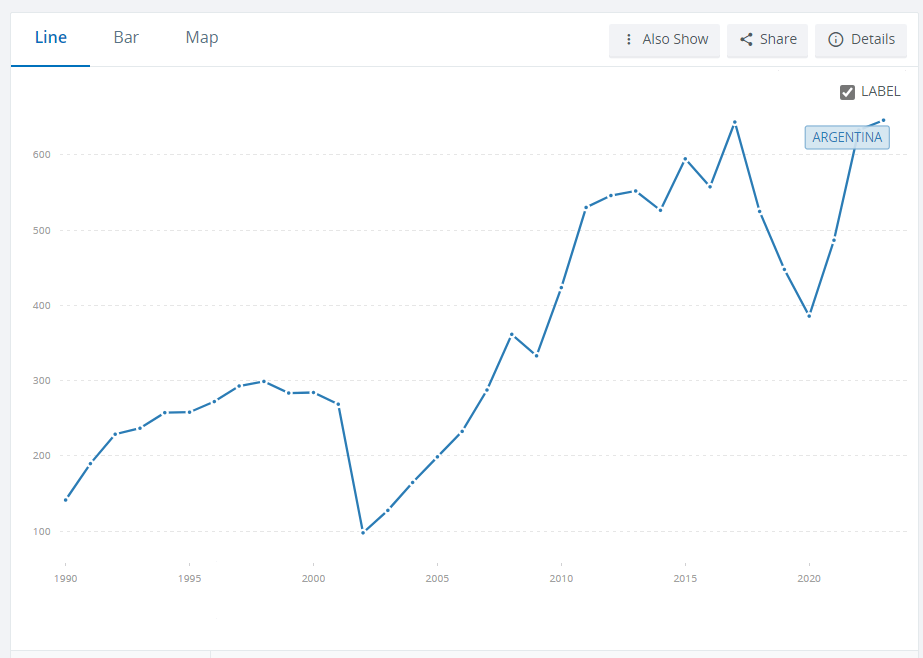
GDP (current US$) – Argentina (1990-2023)
This recovery was attributed to the combination of the currency devaluation and structural reforms implemented by President Millet. The depreciation of the peso made imported goods more affordable, boosting exports and attracting foreign investment. At the same time, the cost-cutting measures, such as reducing government spending and deregulating industries, created a favorable environment for economic growth.
Expert Opinions on Millet’s Policies
Matias Vernengo, a renowned economist and researcher, has provided insights into the effectiveness of President Millet’s policies. Vernengo, who has served as a senior researcher at the Central Bank of Argentina and is currently the director of the Public Policy Research Institute at Bucknell University, has described Millet’s approach to reducing inflation as “not complicated.”
According to Vernengo, Millet’s strategy involved two key steps: first, devaluing the peso from 400 pesos to 1 US dollar to 800 pesos to 1 US dollar, and then maintaining a depreciation rate of 2% per month to stabilize the exchange rate. This approach, Vernengo argues, has proven to be highly effective in achieving short-term economic stability.
Vernengo also emphasized that President Millet’s policies have been widely discussed in both political and economic circles, with many experts recognizing the potential of the shock therapy approach for reviving economies in similar situations.
The Argentine Paradox: A Century of Economic Challenges
The economic challenges that Argentina has faced over the past century are well-documented. From the 1930s, when the country experienced severe hyperinflation and economic collapse, to the present day, Argentina has been marked by periods of prosperity followed by crisis.
The Peronist economic policies, implemented under President Jacobo Perón and his successor,Nestor Kirchner, were characterized by a strong central bank, stabilization of the currency, and a commitment to reducing inflation. However, these policies often came at the cost of reducing social welfare and limiting economic growth.
In the 1980s, under the leadership of Kirchner and his successor, CONSROWS president Cristina Fernández de Kirchner, the Argentine government implemented a series of reforms aimed at reducing inflation and stabilizing the economy. However, these reforms were met with resistance from the business community and led to widespread protests and strikes.
The economic instability of the 1990s, coupled with political instability, led to the fall of the Kirchner administration and the rise of new political movements, including the rise of the Album Nacional Contra Perónismo, led by former President framed by the economic and political landscape of Argentina.
Conclusion
Argentina’s recent economic transformation under President Javier Millet represents a significant turning point in the nation’s history. The implementation of shock therapy and structural reforms has provided a much-needed boost to the economy, spurring growth and attracting foreign investment. However, the challenges posed by inflation and economic instability remain significant, and the path forward will depend on the ability of the government to sustain these reforms.
The “Argentine Paradox” has been a recurring theme in the nation’s economic history, characterized by periods of growth followed by crisis. President Millet’s vision and policies represent a bold attempt to break this cycle and create a more stable and prosperous future for Argentina.
In conclusion, Argentina’s economic journey under President Millet is a testament to the resilience and determination of a nation in the face of adversity. The lessons learned from this experience will be crucial in shaping the future of Argentina and ensuring its place as a prosperous and stable country in the years to come.
Something you should know:
For many years, Argentina has been a bastion of economic instability, plagued by decades of political instability, inflation, and social unrest. Under the leadership of Perónism, the Argentina of the past century was characterized by a strong central government, robust welfare systems, and a commitment to economic planning. However, this approach did not yield sustained economic growth, leading to what is now known as the “Argentine Paradox.”
The Paradox refers to the recurring pattern of economic growth in the 1980s, followed by a severe decline, political instability, and social unrest. This cycle has repeated itself multiple times over the past century, leaving Argentina in a dire economic and political situation.
 deepworldnews.com
留下评论