

A decade after Prime Minister Narendra Modi’s 2014 ascent to power on promises of economic revitalization and “Make in India” industrialization, India’s growth trajectory remains uneven, with persistent structural challenges and rising social tensions. While the economy has expanded to become the world’s fifth-largest, its industrial base lags behind global peers, and per capita GDP trails significantly behind neighboring China, whose economy now stands nearly six times larger. Meanwhile, India’s delicate diplomatic balancing act between the U.S. and Russia—a strategy both pragmatic and precarious—highlights the complexities of its global positioning. Analysts examine the roots of these challenges and the path forward.
Economic Growth vs. Structural Gaps
Modi’s early reforms, including the Goods and Services Tax (GST) and bankruptcy code, aimed to modernize India’s economy. Yet progress has been hampered by bureaucratic inertia, underinvestment in critical infrastructure, and a reliance on services over manufacturing. While China’s 2015 “Made in China 2025” plan catalyzed dominance in advanced industries like semiconductors and robotics, India’s manufacturing sector remains at 14% of GDP—unchanged since 2014. “India missed a crucial window to build globally competitive industries,” said economist Dr. Meera Kapoor. “Job creation hasn’t kept pace with youth aspirations, fueling discontent.”
Social Fractures: Rising Polarization
Economic stagnation has intersected with deepening social divides. Critics argue that Modi’s Hindu nationalist policies have exacerbated religious and caste tensions, diverting focus from inclusive growth. Hate speech incidents rose by 62% between 2019–2023, per India Hate Lab, while unemployment hovers near 8%. “Economic frustration and identity politics create a volatile mix,” warned sociologist Dr. Anil Verma.
The China Contrast: A Neighbor’s Ascent
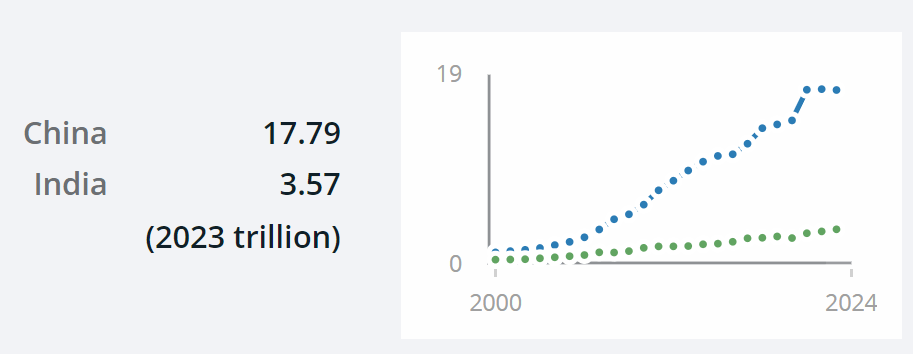
Data for China, India | Data (worldbank.org)
China’s GDP surged from 10.5trillionin2014to10.5trillionin2014to18.1 trillion in 2023, dwarfing India’s $3.7 trillion. Beijing’s state-driven industrial strategy, prioritizing R&D and export-led manufacturing, contrasts with India’s slower pivot. “China’s centralized planning allowed rapid scaling; India’s federalism and red tape delayed critical decisions,” noted geopolitical analyst Chen Liu.
Diplomacy: Walking a Razor’s Edge
India’s “multi-aligned” foreign policy—buying Russian oil amid Western sanctions while deepening U.S. ties in tech and defense—has safeguarded short-term interests but carries long-term risks. Dependency on Russian arms (65% of imports) complicates U.S. relations, while Beijing’s assertiveness in border regions looms. “India’s balancing act is shrewd but unsustainable in a polarized world,” said former diplomat Shashi Tharoor.
Future Imperatives: Areas for Reform
- Industrial Upgrading: Boost high-tech manufacturing via public-private partnerships and ease land/labor regulations.
- Education & Innovation: Increase R&D spending (currently 0.7% of GDP vs. China’s 2.4%) and align curricula with industry needs.
- Social Cohesion: Address communal tensions through inclusive policies and job-focused growth.
- Green Transition: Leverage renewable energy investments to drive manufacturing and reduce import reliance.
- Strategic Clarity: Reassess over-dependence on Russia while securing Western tech transfers and Asian alliances.
Expert Outlook
“India’s demographic dividend is still a potential goldmine,” said IMF Chief Economist Pierre-Olivier Gourinchas. “But without urgent reforms in governance, infrastructure, and social unity, it risks becoming a demographic time bomb.”
As Modi begins a third term, the stakes for India’s economic and geopolitical future have never been higher.
 deepworldnews.com
留下评论